
Testosterone Injection Buy Online: 1# Best Legal TRT Top Guide
15 November, 2025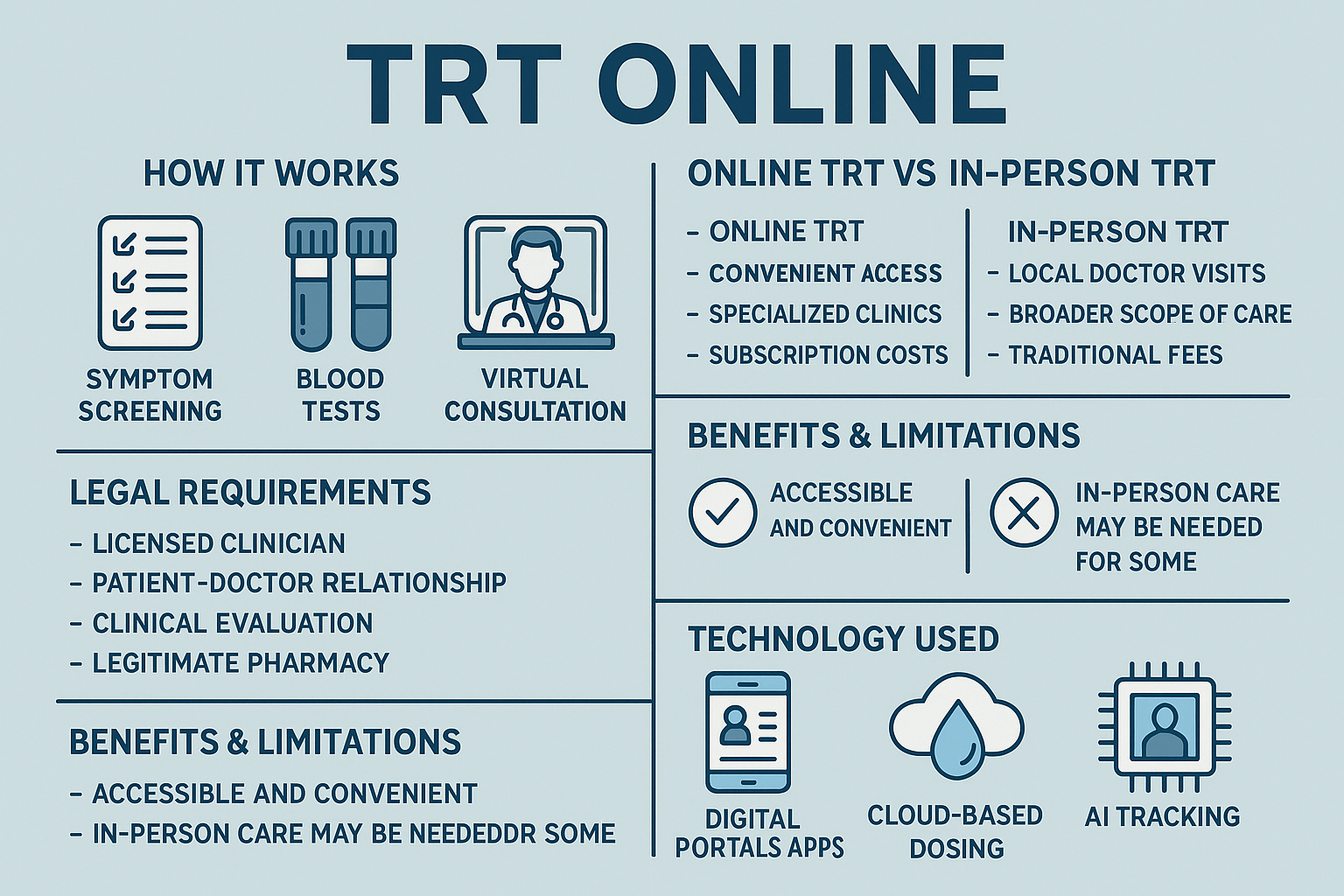
Medical Disclaimer:
This article is for educational purposes only and does not replace professional medical advice, diagnosis, or treatment. Always consult a licensed healthcare provider before starting, changing, or stopping testosterone replacement therapy (TRT) or any medication.
What “TRT Online” Really Means (and What It Does Not Mean)
When people search for “TRT online”, they usually want one of two things:
- A legitimate, doctor-supervised way to treat low testosterone using telemedicine, or
- A shortcut – a way to get testosterone with as little friction as possible.
This article is about the first option only.
TRT online doesn’t mean skipping doctors, skipping lab tests, or getting hormones “on demand.”
In a legitimate, medically sound model, it means:
- Your consultations happen by video or phone instead of in a physical office
- Your lab orders are arranged digitally and done at local labs or via home kits
- Your prescriptions are sent electronically to a licensed pharmacy
- Your follow-ups and dose adjustments are done remotely, but still under medical supervision
Done properly, TRT via telemedicine combines:
- The standards of evidence-based endocrinology, with
- The convenience and accessibility of modern digital healthcare
The goal is not to make testosterone easier to abuse, but to make legitimate care more accessible to men who truly need it.
Why Online TRT Has Exploded in Popularity
Over the last decade, several forces have pushed more men toward telemedicine TRT:
- Increased awareness of low testosterone and hypogonadism
- Busy schedules that make frequent clinic visits difficult
- Greater comfort with telehealth after the COVID-19 pandemic
- More specialized clinics focusing almost exclusively on men’s hormones
- Digital tools that make remote monitoring much easier and safer
For many patients, the old model—waiting months for an appointment, driving to a specialist, taking time off work repeatedly—simply doesn’t fit their life. Telemedicine allows men to access highly specialized hormone care even if they live far from major medical centers.
Who Might Be a Candidate for Online TRT?
Only a qualified healthcare provider can determine whether TRT is appropriate, but in general, online TRT programs are built for men who:
- Have persistent symptoms suggestive of low testosterone (for example: reduced sexual function, unexplained fatigue, diminished strength, or other clinically significant issues)
- Have documented low testosterone levels on appropriate blood testing
- Want a long-term, monitored treatment plan rather than sporadic, unsupervised use
- Are willing to follow medical instructions, complete lab work, and attend follow-up visits
Men with complex medical histories (significant heart disease, active cancer, major psychiatric disorders, uncontrolled sleep apnea, or severe metabolic disease) may still benefit from telemedicine, but often require closer coordination with local specialists and sometimes in-person evaluation.
How Legitimate Online TRT Works: A Step-by-Step Overview
A high-quality online TRT program feels organized and clinical—not like a supplement store. While exact procedures differ between providers, the core structure is similar.
1. Initial Intake and Symptom Screening
You typically start with a detailed online questionnaire that asks about:
- Symptoms (energy, libido, mood, performance, sleep, etc.)
- Past and current medical conditions
- Medications and supplements
- Family history (especially heart disease, prostate cancer, clotting disorders)
- Lifestyle factors (weight, exercise, alcohol, tobacco, sleep habits)
This isn’t just marketing—done properly, it helps the clinician judge whether TRT is even worth exploring or whether other diagnoses should be considered first.
A serious clinic will not guarantee TRT before this evaluation
and will not promise life-changing results in a few days.
2. Objective Testing: Lab Work Comes First
Telemedicine doesn’t remove the need for blood tests. In fact, good online programs often require more thorough lab panels than a rushed in-person visit might.
Typically, you’ll be asked to complete labs through:
- A partner laboratory network (you go in person for a blood draw), or
- A home-based collection solution, such as mobile phlebotomy or validated home sampling kits, if available and appropriate
Commonly assessed markers (exact panels vary by clinic) may include:
- Total and/or free testosterone
- Other hormone markers (as indicated)
- Blood counts and PSA for safety monitoring
- Metabolic and cardiovascular risk parameters
The goal is two-fold:
- Confirm whether testosterone is genuinely low or borderline under accepted medical criteria
- Evaluate whether TRT would be safe, or whether other health priorities must come first
3. Telehealth Consultation with a Licensed Clinician
Once labs are available, you’ll typically have a video or phone consultation with:
- An endocrinologist
- A urologist
- An internal medicine physician
- Or a nurse practitioner/physician assistant working under protocol with supervising physicians
During this visit, a legitimate provider will:
- Review your symptoms and lab values together
- Ask about fertility goals (TRT can affect sperm production)
- Screen for contraindications and relative risks
- Discuss non-TRT options when appropriate (weight loss, sleep optimization, treatment of coexisting conditions, etc.)
At the end of that conversation, one of several outcomes is possible:
- You qualify for TRT, and the clinician offers a treatment plan
- You do not meet criteria; the provider may recommend observation, repeat testing, or other evaluation
- You have red-flag issues that must be addressed first (cardiac issues, prostate concerns, uncontrolled sleep apnea, etc.)
If a “TRT clinic” never says no to anyone, that’s a major warning sign.
Real medicine sometimes says no.
4. Designing a Personalized Treatment Plan
If TRT is appropriate, the next step is to define your treatment strategy. While this article won’t prescribe specific drugs or doses (that must come from your own provider), a typical plan will include:
- The form of testosterone (for example, injections, topical formulations, or other doctor-approved forms)
- Frequency of administration (weekly, every few days, or as medically indicated)
- Monitoring schedule—when to repeat labs, when to follow up
- Supportive measures such as lifestyle improvements, adjunctive medications if indicated, and risk-mitigation strategies
What matters most is that the plan is documented, you understand it, and you know how success and safety will be measured over time.
5. Pharmacy Fulfillment and Home Delivery
Once the prescription is written, it’s sent electronically to:
- A retail or chain pharmacy, or
- A partner compounding or specialty pharmacy that ships directly to your home
A key principle here: the pharmacy must be licensed and must require a valid prescription. If a service claims to send you testosterone without any prescription or lab work, that’s not telemedicine—that’s a legal and medical risk.
A legitimate shipment typically includes:
- The medication itself (in the form prescribed)
- Usage instructions and safety information
- Devices or supplies needed to administer the therapy (when appropriate)
- Contact information for questions or concerns
6. Follow-Up, Monitoring, and Long-Term Care
TRT is not a “set it and forget it” therapy. The most important difference between responsible TRT and dangerous hormone use is what happens after you start.
Quality online TRT programs will:
- Recheck labs at intervals recommended by clinical guidelines (for example, several months after starting or changing dose, then periodically once stable)
- Adjust your treatment based on:
- Symptom response
- Lab markers
- Side effects
- Monitor for potential complications
- Track long-term trends, not just single lab values
You should have clear access to:
- Follow-up telehealth visits
- Messaging support for new symptoms, side effects, or practical questions
- Education on injection technique, medication handling, and risk awareness (where applicable)
If your provider starts you on TRT, then is almost impossible to reach afterward, that’s a red flag.
Online TRT Clinics vs Traditional Practices: A Detailed Comparison
Both online TRT services and conventional clinics can deliver excellent care—but they excel in different areas.
Convenience and Accessibility
- Online TRT
- Minimal travel
- Easier scheduling (evening or weekend appointments in some cases)
- Accessible for patients in geographically remote areas
- Traditional in-person care
- Requires travel and time off
- May be limited by geographical access to specialists
Scope and Specialization
- Online TRT programs often focus exclusively on male hormone health.
- Advantage: deep experience with testosterone-related issues
- Limitation: narrower view of your overall health unless they coordinate with your primary care provider
- Primary care doctors or general endocrinologists treat a broad range of conditions.
- Advantage: more holistic understanding of your health
- Limitation: may have less time and fewer dedicated protocols for TRT specifically
Cost Structure
- Telemedicine TRT often uses membership or subscription models, which can bundle:
- Medical visits
- Messaging access
- Prescription management
- Sometimes lab work and medication
- Traditional clinics often use a fee-for-service model, where:
- Each visit, lab test, and prescription is billed separately
- Insurance may help with some or all of these costs, depending on your plan
Relationship with Your Broader Healthcare
Ideally, your hormone care is integrated with the rest of your medical life.
- Some online TRT clinics encourage you to share lab results and treatment summaries with your primary care doctor.
- Others function more like standalone programs, which can create silos.
A good sign is when the clinic welcomes coordination with your existing healthcare team.
Legal and Regulatory Considerations for TRT Online (High-Level Overview)
Telemedicine for controlled substances such as testosterone must operate inside a defined legal framework. While specific requirements vary by jurisdiction and evolve over time, several core principles tend to be consistent:
- The prescriber must be properly licensed in the region where the patient is located
- There must be a valid clinician–patient relationship
- A clinical evaluation is required before prescribing
- Prescriptions must go through legitimate pharmacies
- Telemedicine prescribing of controlled substances must follow national and local rules (for example, requirements about in-person evaluation at some point in the relationship)
The takeaway:
If a service advertises “no doctor, no labs, no problem,” it is almost certainly not compliant with medical or legal standards.
How to Evaluate an Online TRT Provider: A Practical Checklist
Before you sign up with any online TRT clinic, ask questions like these:
1. Credentials and Clinical Leadership
- Are the supervising clinicians board-certified in relevant specialties (endocrinology, urology, internal medicine, etc.)?
- Is there a clear medical director with published qualifications?
- Are you able to see who will be managing your case, not just a brand name?
2. Diagnostic Rigor
- Do they require pre-treatment lab work?
- Are diagnostic criteria explicitly discussed (for example, how they define low testosterone)?
- Do they ever decline to start TRT if criteria are not met?
Legitimate clinics are willing to explain why they treat, and why they sometimes do not.
3. Monitoring Protocols
- How often do they repeat labs once you’re on therapy?
- Is there a written monitoring plan—not just “we’ll check occasionally”?
- Do they address fertility considerations, cardiovascular risk factors, and prostate health where relevant?
4. Transparency Around Costs
- Are you given a clear breakdown of:
- Consultation fees
- Membership or subscription charges
- Lab costs
- Medication costs
- Are there extra charges for follow-up messages or dose changes?
Opacity around pricing is often a red flag.
5. Data Privacy and Security
- Is your medical data stored in a secure, compliant system?
- Do they explain how your information is used, stored, and shared?
- Are you comfortable with their digital practices?
The Role of Technology in Modern Online TRT Care
High-quality online TRT is more than video calls and shipping labels. Many clinics are now integrating advanced technology to improve safety, adherence, and patient experience.
Digital Portals and Apps
Most established programs provide a patient portal where you can:
- View lab results
- Track your treatment history
- Access visit summaries
- Request refills or schedule appointments
Some add mobile apps with:
- Reminders for injections or medication doses
- Symptom tracking journals
- Secure messaging with clinical staff
Data-Driven Treatment Adjustments
Over time, a good TRT provider accumulates data on:
- Your laboratory trends
- Your self-reported symptom changes
- Any side effects or complications
When combined, this information allows for:
- More precise dose adjustments
- Better understanding of your individual sensitivity to treatment
- Earlier detection of potential safety issues
Future Directions: Remote Monitoring and AI-Assisted Care
Emerging technologies may further refine TRT care, such as:
- Wearables that monitor sleep, activity, heart rate, and potentially flag changes that matter in hormone therapy
- Decision-support systems that help clinicians interpret trends and manage complex cases more consistently
These tools are assistance for clinicians, not replacements for medical judgment, but they can enhance the safety and personalization of telemedicine TRT.
What to Expect During the First Year of Online TRT
While every patient’s journey is unique, many men experience the first year of medically supervised online TRT in several phases:
Phase 1: Evaluation and Decision
- You complete the intake and labs
- You meet with a clinician
- You decide jointly whether TRT is appropriate
During this stage, realistic expectations should be set. TRT is not a miracle cure for every symptom in life. It’s a specific therapy for a specific diagnosis.
Phase 2: Initiation of Therapy
When treatment begins, early priorities include:
- Learning how to correctly use the form of testosterone prescribed to you
- Understanding what to watch for in terms of side effects
- Establishing a consistent routine
Your provider should give you clear instructions and be available for questions.
Phase 3: Adjustment and Optimization
As your body responds, your clinician may fine-tune:
- Dose
- Dosing frequency
- Supportive measures
This is where follow-up labs and symptom check-ins are crucial. The aim is to balance:
- Relief of clinically relevant symptoms, with
- Maintenance of safe lab parameters, and
- Minimization of adverse effects
Phase 4: Long-Term Maintenance
Once an effective and safe regimen is found, TRT becomes ongoing maintenance:
- Periodic labs
- Scheduled follow-ups
- Occasional adjustments as your health evolves
TRT is usually a long-term commitment. Understanding this from the beginning helps you evaluate whether it truly matches your goals, risk tolerance, and lifestyle.
Benefits and Limitations of TRT Online
Potential Benefits
- Access to specialized hormone care regardless of location
- Convenience with fewer work disruptions and travel demands
- Consistency in monitoring and follow-up, thanks to structured digital systems
- Specialization, as many telemedicine clinics focus almost entirely on hormone therapy
Important Limitations
- Not all patients are ideal candidates for fully remote management; some require in-person evaluation for parts of their care
- Telemedicine cannot replace emergency services or certain types of physical examinations
- Integration with your existing medical team depends on how well information is shared
- Quality varies widely between providers; some operate at high standards, others cut corners
If you want more information click here Testosterone Injection Buy Online
Key Questions to Ask Before Starting an Online TRT Program
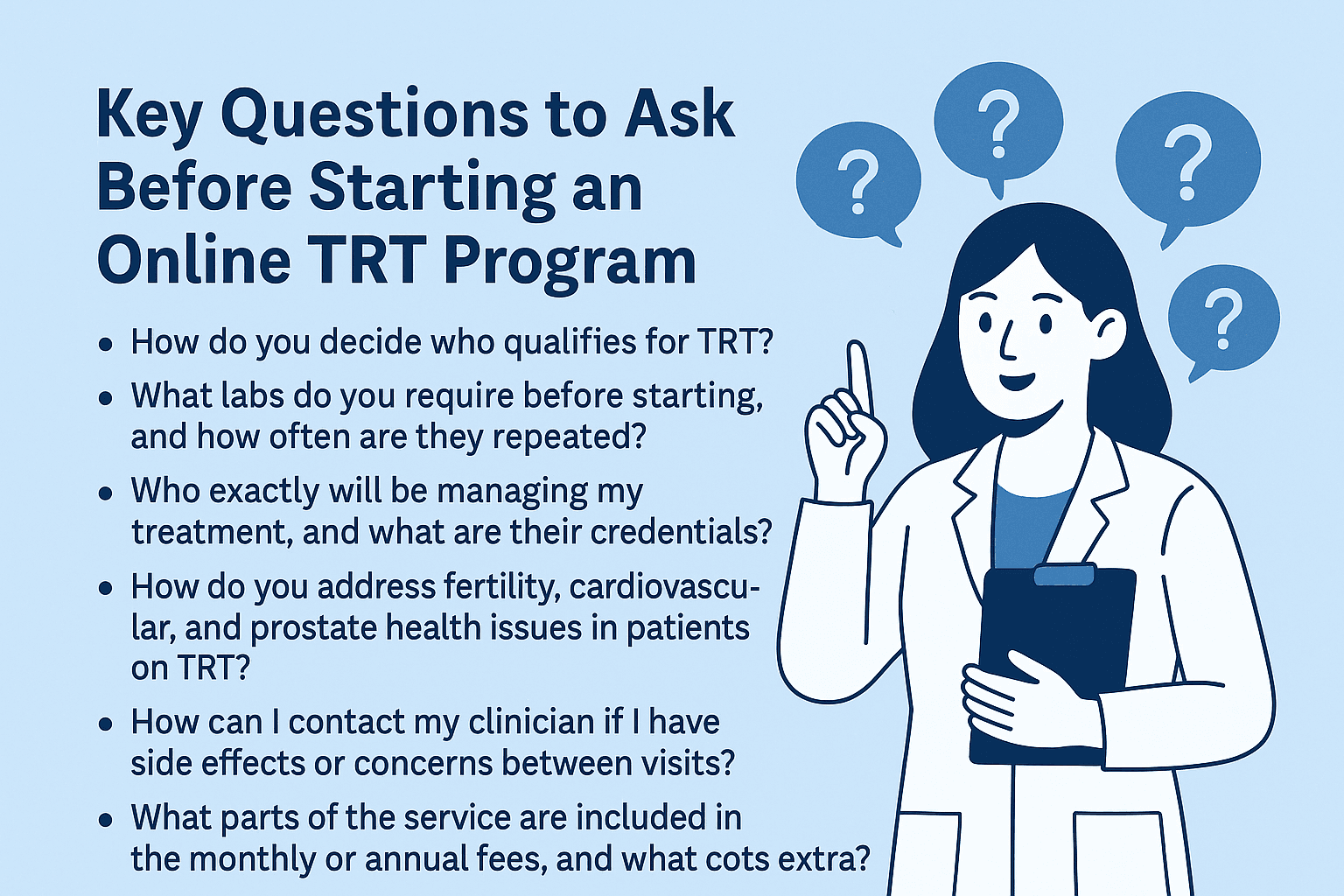
How do you decide who qualifies for TRT?
A legitimate TRT clinic determines eligibility by combining documented clinical symptoms with laboratory results from properly timed testosterone tests. A qualified provider will confirm low hormone levels on morning blood work, evaluate your medical history, rule out other conditions that mimic low testosterone, and ensure TRT is medically appropriate before offering treatment. Any clinic that approves patients without labs or fails to explain its diagnostic criteria should be approached with caution.
What labs do you require before starting, and how often are they repeated?
A responsible TRT provider requires baseline blood work—including testosterone levels, blood count, prostate markers as appropriate for age, and cardiovascular-related labs—and repeats these tests after the initial phase of treatment to ensure safety and therapeutic effectiveness. Follow-up labs typically occur within the first few months and continue at regular intervals throughout treatment, ensuring ongoing monitoring of hormone levels and health markers.
Who exactly will be managing my treatment, and what are their credentials?
Before starting an online TRT program, you should know which clinician will manage your care and what formal qualifications they hold. Ethical clinics make it easy to verify the provider’s name, professional license, board certification, and clinical experience in men’s hormone management. Transparent credentials indicate a trustworthy practice, while vague or hidden provider identities are red flags.
How do you address fertility, cardiovascular, and prostate health issues in patients on TRT?
A high-quality TRT program proactively addresses major health considerations by evaluating fertility goals, cardiovascular risk factors, and age-appropriate prostate health before therapy begins. A responsible clinician explains how TRT may affect sperm production, reviews heart and metabolic risks, and determines whether additional testing or monitoring is necessary. This level of assessment demonstrates a commitment to long-term patient safety.
How can I contact my clinician if I have side effects or concerns between visits?
Reliable TRT clinics provide direct and timely access to your clinician through secure telemedicine platforms, allowing you to report side effects, ask questions, or request adjustments as needed. The ability to communicate quickly and receive personalized guidance is essential for safe hormone therapy, and inconsistent communication is a sign of an inadequate service.
What parts of the service are included in the monthly or annual fees, and what costs extra?
Cost transparency is crucial when evaluating TRT programs, and reputable clinics clearly explain which services are included in their fees, such as consultations, follow-ups, and ongoing messaging support. A trustworthy provider also specifies additional charges that may apply to lab work, medication refills, or optional services, ensuring you understand the full financial commitment before enrolling.
Do you coordinate with my primary care doctor if I request it?
A responsible online TRT provider is willing to coordinate with your primary care physician to support continuity of care. If you request it, they can share lab results, treatment summaries, or relevant updates so your broader health team remains informed. This collaboration helps maintain comprehensive oversight of your overall well-being.
What happens if my labs or symptoms suggest TRT is not appropriate for me after I sign up?
If your evaluation or follow-up results indicate that TRT is not medically appropriate, an ethical clinic will explain the reasons clearly and guide you toward safer alternatives or additional testing. A reputable provider prioritizes patient safety over program enrollment and will not continue therapy if the risks outweigh the potential benefits.
The best clinics will welcome these questions and answer them clearly.
Conclusion: Using Online TRT Safely, Legally, and Intelligently
TRT online is not a shortcut—it’s a modern way of delivering the same kind of medically supervised care that should exist in any responsible hormone practice.
When done correctly, a telemedicine-based TRT program will:
- Confirm that you truly have clinically significant low testosterone
- Evaluate whether TRT is safe for you specifically
- Explain benefits, limitations, and risks in plain language
- Provide a structured treatment plan
- Follow recognized clinical guidelines for monitoring
- Adapt your therapy as your health and life circumstances evolve
The convenience of video visits and home delivery should never replace the fundamentals of good medicine.
If you’re considering online TRT:
- Start by educating yourself (as you’re doing now)
- Seek providers who demonstrate experience, transparency, and caution
- Be ready to commit not just to a prescription—but to long-term, collaborative care
With the right team and the right expectations, TRT delivered through telemedicine can be safe, legal, and effective, helping appropriately selected men address genuine hormone deficiency in a way that fits modern life.