


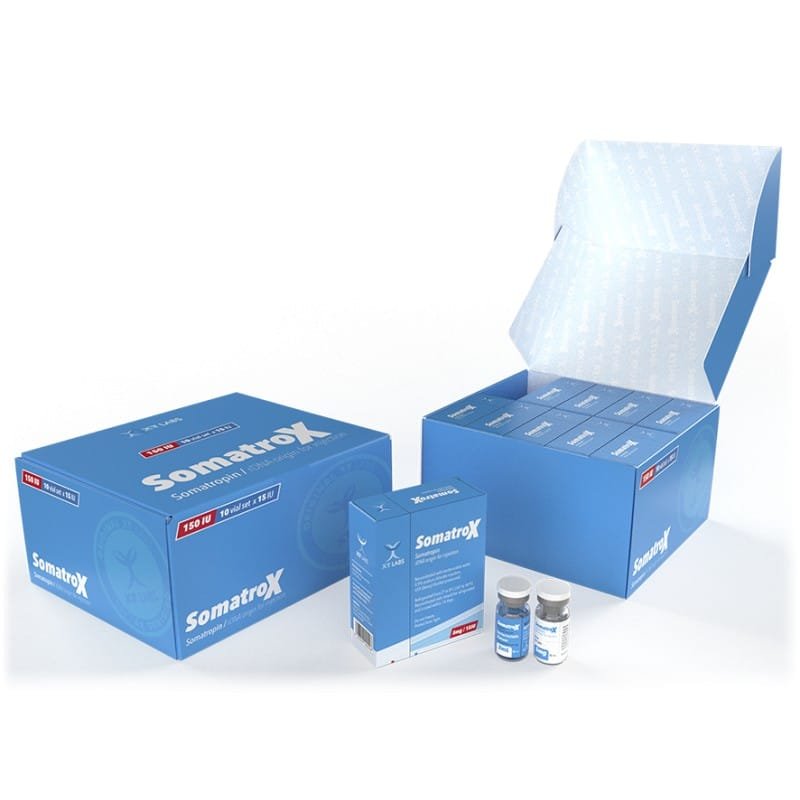
Somatrox 150 UI XT LABS HGH: Best USA Medical Uses, Bodybuilding Risks
Somatrox 150 UI is a high-potency somatropin formulation designed to deliver recombinant human growth hormone (HGH). In a medical context, somatropin is used to support growth and metabolic functions by stimulating IGF-1 production, promoting protein synthesis, and influencing body composition. It is typically associated with applications such as growth hormone deficiency and other endocrine-related conditions, while also being recognized in fitness contexts for its effects on lean mass and fat metabolism.
Somatrox 150 UI Xt labs and HGH
Human growth hormone is the endogenous pituitary hormone GH, while somatropin is the recombinant, 191–amino-acid therapeutic form used in medicine. In legitimate clinical practice, somatropin is prescribed for specific pediatric and adult indications, started only after diagnostic confirmation and contraindication screening, and then titrated to response and safety markers such as IGF-1, glucose tolerance, thyroid status, adrenal status, eye symptoms or papilledema, and—when relevant—tumor recurrence surveillance. In contrast, bodybuilding or performance use is not a standard medical indication, and the best athlete data show a much weaker evidence base than users often assume: body composition may shift, but consistent gains in muscle strength, power, or aerobic performance have not been demonstrated, while risk still accumulates. Organized sport adds another layer: GH remains prohibited by the World Anti-Doping Agency.
For the exact keyword “Somatrox 150 UI”, authoritative indexed clinical literature was not identified in the sources reviewed; exact-keyword searches surfaced commercial storefront pages rather than peer-reviewed medical monographs or trials. Because of that, the medically responsible way to interpret the term is through the somatropin drug class and the unit expression itself, not as a validated therapeutic standard. Based on approved product conversions in official product information, 5 mg somatropin corresponds to 15 IU/UI, so 150 IU/UI nominally corresponds to about 50 mg total somatropin if the label is accurate. That total-content figure still does not substitute for diagnosis-based dosing, which varies markedly by age, body weight, indication, formulation, and monitoring strategy.
This article therefore treats Somatrox 150 UI as a product keyword that requires clinical interpretation, not as an evidence-backed dosing recommendation. The central takeaway is simple: in medicine, HGH therapy is a diagnosis-driven endocrine replacement or growth therapy; in bodybuilding, it is a nonstandard, higher-risk, weakly validated practice with anti-doping implications and a much less favorable benefit-to-certainty ratio.
HGH and Somatropin Fundamentals
Physiology and pharmacology
GH is a pituitary peptide hormone that regulates longitudinal growth, body composition, metabolism, and tissue remodeling through both direct GH receptor signaling and indirect effects mediated by insulin-like growth factor 1. Recombinant somatropin is designed to reproduce native human GH, and approved labels describe it as having an amino acid sequence identical to pituitary-derived human growth hormone. Its clinically relevant actions include stimulation of chondrocyte differentiation and proliferation, protein synthesis, lipolysis, and metabolic effects that include increased hepatic glucose output.
That physiology matters because replacement and enhancement are not the same thing. In genuine GH deficiency, therapy aims to restore a deficient endocrine axis toward a physiological range. In healthy adults seeking physique or performance changes, the same hormone is being used outside a deficiency model, usually at supraphysiologic exposure, where expected benefit is less certain and dose-related toxicity becomes more relevant. The Endocrine Society’s adult GHD guidance emphasizes benefits in body composition, exercise capacity, skeletal integrity, and quality of life in appropriately selected GH-deficient adults, while athlete-focused reviews emphasize how much weaker the evidence is in healthy users.
Why medical replacement differs from performance use
The most important conceptual distinction is indication. Medical somatropin is used because a patient has GH deficiency or another evidence-based growth disorder, not because increasing GH sounds anabolic. Labels and guidelines require confirmation of the diagnosis, assessment of alternative causes, individualized titration, and longitudinal monitoring. Bodybuilding use, by contrast, commonly begins from a desired aesthetic or performance endpoint rather than a verified endocrine diagnosis. That difference drives the entire risk-benefit equation.
Medical Use of Somatropin
Approved clinical indications
Across approved products, medical somatropin indications include pediatric growth failure from GH deficiency and several other pediatric disorders depending on brand, including Prader-Willi syndrome, small for gestational age without catch-up growth, Turner syndrome, idiopathic short stature, Noonan syndrome, SHOX deficiency, and growth failure associated with chronic kidney disease. In adults, approved GH-related uses include adult growth hormone deficiency, HIV-associated wasting/cachexia, and short bowel syndrome with specialized nutritional support. Not every brand carries every indication, but the class is well established in these disease-specific settings.
In children, the treatment objective is primarily improved linear growth and eventual adult-height outcomes, with some conditions also showing favorable effects on body composition. In adults with bona fide GHD, the therapeutic goal is different: less about stature and more about fat mass reduction, lean mass improvement, skeletal health, exercise capacity, and quality of life. Long-term observational data and recent reviews continue to support meaningful benefit when treatment is correctly targeted to the right patient population.
Diagnosis and baseline evaluation
Adult GHD is frequently not diagnosed by symptoms or IGF-1 alone. The Endocrine Society states that confirmation usually requires GH stimulation testing, unless there is a clearly established persistent childhood genetic or structural lesion. Current adult reviews make the same point: the only reliable diagnostic approach is failure of GH to rise appropriately during pharmacologic stimulation testing, interpreted in the right clinical context. Patients treated in childhood usually require reevaluation after epiphyseal closure before continuing adult-dose therapy unless they fall into established exception categories.
Baseline assessment should also be broader than just “low GH.” The practical endocrine workup usually includes review of other pituitary axes, tumor history, current glucocorticoid or thyroid replacement, glucose status, and baseline IGF-1. Several current labels also instruct clinicians to consider a fundoscopic examination before initiation to exclude preexisting papilledema and to repeat it if symptoms raise concern for intracranial hypertension. This broader pre-treatment approach is part of what separates medical somatropin from nonmedical GH use.
Somatrox 150 UI Xt labs Dosing and administration

Somatrox 150 UI Xt labs Dosing and administration
Daily somatropin dosing is indication-specific, not product-keyword-specific. A current OMNITROPE label gives typical pediatric ranges of 0.16–0.24 mg/kg/week for pediatric GHD, 0.24 mg/kg/week for Prader-Willi syndrome, up to 0.48 mg/kg/week for SGA, 0.33 mg/kg/week for Turner syndrome, and up to 0.47 mg/kg/week for idiopathic short stature, divided into 6–7 subcutaneous injections per week. For adults with GHD, the same label describes a weight-based starting approach of no more than 0.04 mg/kg/week, titratable to no more than 0.08 mg/kg/week, or a non–weight-based starting dose of about 0.2 mg/day with gradual adjustments based on clinical response and IGF-1. Injection sites should be rotated to reduce lipoatrophy.
Approved long-acting GH analogs have different pharmacokinetics and product-specific schedules, so they are not simple unit-for-unit substitutes for daily somatropin. Current U.S. labeling states that SOGROYA is used once weekly, with adult GHD initiation at 1.5 mg weekly and pediatric GHD initiation at 0.16 mg/kg weekly; SKYTROFA is labeled for pediatric GHD at 0.24 mg/kg once weekly; and NGENLA is labeled for pediatric GHD with once-weekly administration under specialist supervision. Recent consensus work emphasizes that long-acting products are molecularly distinct from daily somatropin and require product-specific monitoring strategy, including attention to timing of IGF-1 interpretation.
A clinically important nuance is that adult dosing is individualized more aggressively than pediatric dosing. Older adults tend to need lower starting doses and smaller increments, and women receiving oral estrogen may need higher doses. That is one reason a label such as “150 IU” is clinically incomplete: it says nothing about patient age, diagnosis, weight, sex-hormone context, or titration target.
Monitoring, adverse effects, and contraindications
Medical monitoring is not optional. Current labels call for attention to serum IGF-1, glucose intolerance/diabetes, thyroid function, cortisol status or glucocorticoid requirements, intracranial hypertension, fluid retention, and—in the appropriate population—tumor progression or recurrence. Pediatric care adds surveillance for slipped capital femoral epiphysis, scoliosis progression, and specific airway risk in Prader-Willi syndrome. Adults more often experience dose-dependent fluid-retention syndromes such as edema, arthralgia, myalgia, paresthesias, and carpal tunnel symptoms.
The major class contraindications are consistent across approved products: acute critical illness, active malignancy, active proliferative or severe non-proliferative diabetic retinopathy, closed epiphyses when the goal is growth promotion, and high-risk pediatric Prader-Willi syndrome with severe obesity or severe respiratory compromise. These warnings are not merely theoretical. Approved labels note increased mortality when pharmacologic somatropin was given to critically ill non-GHD adults in ICU studies, which is why GH is contraindicated in that setting.
For clinicians and informed patients, the most practical question is not “How many IU are in the box?” but rather: What is the diagnosis, what is the mg-per-dose exposure, and what exactly is being monitored over time? That is the frame used by endocrine care, and it is the frame in which somatropin has its strongest evidence base.
HGH in Bodybuilding and Performance Settings
What users usually seek
In bodybuilding and adjacent “anti-aging” or “recomp” cultures, GH is typically pursued for fat loss, fuller or denser lean mass, recovery, and a hoped-for synergy with anabolic steroids or testosterone. The culture around use often treats GH as broadly anabolic. Yet the scientific literature repeatedly finds that many of those expectations are either overstated or only partially supported. Recent aging reviews likewise describe persistent interest in GH as an anti-aging strategy, but emphasize inconsistent functional outcomes and substantial controversy.
What the evidence actually shows
The best human data do not support the popular idea that GH reliably makes healthy adults stronger, more powerful, or aerobically fitter. A major endocrine review concluded that in recreational athletes GH may selectively improve anaerobic sprint capacity, but it has not been shown to enhance muscle strength, power, or maximal oxygen consumption in a consistent way. A meta-analysis likewise found limited evidence of athletic-performance benefit in healthy young subjects.
That does not mean GH does nothing in healthy users. Randomized athlete studies and review summaries show shifts in body composition, especially reduced fat mass and increased lean mass. The catch is that some of the apparent lean-mass increase appears to reflect extracellular water and fluid retention, not purely contractile muscle gain. That is exactly why relying on before-and-after appearance alone can be so misleading in bodybuilding contexts.
Dosing context, risks, and anti-doping
There is no medically endorsed bodybuilding dose of HGH. In athlete research, supraphysiologic regimens have included examples such as 2 mg/day subcutaneously or 0.1–0.2 IU/kg/day, and sports-endocrinology reviews describe anecdotal abuse at many times normal daily production. Those numbers are useful only to show how different nonmedical exposure can be from diagnosis-guided endocrine replacement; they should not be read as recommendations.
The risk profile in bodybuilding is not separate from medical toxicology—it is usually worse, because users may combine GH with anabolic steroids, insulin, thyroid hormone, or stimulants, and often do so without objective diagnosis or systematic follow-up. The same class warnings apply: edema, arthralgia, carpal tunnel symptoms, glucose intolerance or overt diabetes, intracranial hypertension, pancreatitis, and concern for neoplasia surveillance in susceptible patients. Labels also warn that chronic overexposure can produce signs compatible with acromegaly or gigantism.
From a sports-governance standpoint, GH is clearly in the prohibited space. WADA’s Prohibited List framework covers peptide hormones and related substances, and WADA’s GH-deficiency TUE guidance explicitly notes the significant risk of abuse for performance enhancement, which is why athletes requiring genuine GH replacement need strict diagnostic documentation and specialist confirmation.
Medical vs Bodybuilding Comparison
| Domain | Medical somatropin use | Bodybuilding or performance use |
|---|---|---|
| Primary purpose | Replace deficient GH action or treat evidence-based growth disorders | Improve physique, fat loss, recovery, or hoped-for ergogenic effect |
| Candidate selection | Diagnosis-driven, usually with endocrine testing and contraindication screening | Goal-driven, often without verified endocrine disease |
| Typical dosing frame | Indication-specific, weight/age/product based; titrated to response and IGF-1 | No medically endorsed standard; supraphysiologic regimens are described in athlete literature |
| Route and schedule | Subcutaneous injection; daily somatropin or product-specific weekly analogs | Usually subcutaneous, but regimen choice is nonstandard and often stacked with other PEDs |
| Expected outcomes | Better growth velocity/adult height in children; better body composition, QoL, and exercise capacity in adults with GHD | Body-composition changes possible; strength/power/VO2 gains are not consistently demonstrated |
| Monitoring | IGF-1, glucose, thyroid, cortisol, tumor history, papilledema symptoms, pediatric orthopedic issues | Often absent in practice, but the same medical monitoring would be needed to detect complications |
| Major risks | Fluid retention, glucose intolerance, intracranial hypertension, thyroid/adrenal effects, SCFE, PWS airway risk, neoplasm surveillance | Same risks, usually amplified by higher exposure, stacking, and lack of supervision |
| Contraindications | Acute critical illness, active malignancy, severe diabetic retinopathy, closed epiphyses for growth promotion, high-risk PWS | Class contraindications still apply; there is no exemption just because the goal is physique or performance |
| Status in organized sport | Permitted only with legitimate medical indication and, for athletes, appropriate TUE processes | Prohibited by WADA |
The table above synthesizes endocrine guidance and approved labels for medical dosing and safety, plus athlete trials, meta-analyses, and anti-doping guidance for nonmedical use. The key divide is that medical somatropin aims to normalize a disordered axis, whereas bodybuilding use aims to push physiology for appearance or performance despite weaker efficacy data and a still-material adverse-effect burden.
Clinical Interpretation of Somatrox 150 UI
This review intentionally treats Somatrox 150 UI as a clinical keyword, not as a validated medical standard. In the sources reviewed, exact-keyword searches surfaced commercial retail listings rather than indexed clinical trials, formal practice guidelines, or major reference monographs for the exact name. That means product-specific clinical assertions cannot be confirmed from authoritative biomedical literature in the same way they can for approved somatropin brands and analogs.
What can be inferred from the unit expression
One useful inference can be made from official product information. In English-language EMA product information for Omnitrope, 5 mg corresponds to 15 IU and 10 mg corresponds to 30 IU; in Spanish-language EMA product information for the same active substance, the equivalent unit is written UI rather than IU. So, in clinical terms, UI and IU are the same potency notation here, and 150 UI nominally maps to about 50 mg total somatropin if the stated potency is accurate.
That total figure is not a treatment plan. A package containing 150 IU/50 mg could represent very different treatment durations depending on the patient and indication. For example, an adult GHD starting dose of about 0.2 mg/day equals roughly 1.4 mg/week, whereas a 30-kg child treated for pediatric GHD at 0.16–0.24 mg/kg/week would use about 4.8–7.2 mg/week. In HIV-associated wasting, the usual starting dose can reach 0.1 mg/kg/day up to 6 mg/day, which consumes total drug far faster. The same total-content label therefore spans months of low-dose adult replacement, weeks of pediatric therapy, or barely more than a week in high-dose catabolic disease treatment.
How it compares conceptually with approved HGH products
Approved products come with publicly validated concentrations, indication-specific dosing logic, administration devices, and formal monitoring language. Examples in current labeling include OMNITROPE cartridges at 5 mg/1.5 mL and 10 mg/1.5 mL, SOGROYA prefilled pens at 5, 10, and 15 mg/1.5 mL, SKYTROFA’s multiple prefilled cartridge strengths for pediatric weekly dosing, and NGENLA’s once-weekly pediatric pen system. Just as importantly, long-acting products are not pharmacokinetically identical to daily somatropin, so their dose interpretation and IGF-1 monitoring are product-specific. For that reason, the safest medical reference point for a keyword like Somatrox 150 UI is the approved somatropin class and its validated dosing principles, not the keyword alone.
Clinical Decision Tools
The following diagrams summarize a label- and guideline-based way of thinking about HGH therapy. They are not a substitute for endocrinology care, but they do reflect the practical sequence emphasized in current labels and endocrine guidance: confirm indication, exclude contraindications, select the correct formulation, titrate carefully, and monitor for both benefit and toxicity.
Typical HGH treatment course timeline
HGH therapy decision flowchart
| Stage | Description |
|---|---|
| Symptom Recognition | Short stature, poor growth velocity, or adult growth hormone deficiency (GHD) phenotype. |
| Diagnostic Confirmation | Endocrine evaluation, stimulation testing when needed, and review of alternative causes. |
| Baseline Safety Review | Assessment of IGF-1, thyroid and adrenal function, glucose levels, tumor history, and fundoscopic exam if indicated. |
| Treatment Initiation | Start daily somatropin or an approved once-weekly analog based on indication. |
| Early Adjustment | Adult dose titration every 1–2 months based on symptoms and IGF-1 levels. |
| Ongoing Follow-Up | Monitor growth velocity or body composition/quality of life, rotate injection sites, and track adverse effects. |
| Reassessment | Evaluate for poor response, papilledema, hyperglycemia, tumor concerns, or transition from pediatric to adult care. |
HGH Therapy Decision Flow
| Step | Decision / Action |
|---|---|
| 1 | Suspected GHD or approved indication |
| 2 | Is diagnosis confirmed and alternative causes addressed? |
| If No → Do not start HGH; complete diagnostic workup | |
| 3 | Any contraindication present? |
| If Yes → Do not start; treat underlying condition first | |
| 4 | Choose approved formulation and starting dose based on age, indication, and weight |
| 5 | Educate patient on subcutaneous administration, site rotation, adherence, and monitoring plan |
| 6 | Monitor IGF-1, clinical response, glucose, thyroid, cortisol, and safety signals |
| 7 | Does benefit exceed risk? |
| If No → Adjust dose, reassess diagnosis/adherence, or discontinue | |
| If Yes → Continue with periodic review and long-term reassessment |
Frequently Asked Questions (FAQ) – Somatrox 150 UI XT Labs
What is Somatrox 150 UI XT Labs?
Somatrox 150 UI refers to a somatropin-based formulation containing recombinant human growth hormone (HGH). Somatropin is a synthetic version of endogenous growth hormone used in clinical endocrinology to regulate growth, metabolism, and tissue repair.
How does somatropin (HGH) work in the body?
Somatropin acts by binding to growth hormone receptors and stimulating the production of insulin-like growth factor 1 (IGF-1), primarily in the liver. This pathway promotes cellular growth, protein synthesis, lipolysis, and overall metabolic regulation.
What are the medical uses of HGH (somatropin)?
In a clinical setting, somatropin is used for:
-
Growth hormone deficiency (GHD) in children and adults
-
Pediatric growth disorders (e.g., Turner syndrome, small for gestational age)
-
Muscle wasting conditions such as HIV-associated cachexia
-
Support in specific metabolic or endocrine disorders
Is Somatrox 150 UI used in bodybuilding?
HGH is sometimes used in bodybuilding contexts for its potential effects on fat metabolism and lean body mass. However, scientific evidence shows that while body composition may change, improvements in strength or athletic performance are not consistently supported.
What are the potential benefits of HGH therapy?
When medically indicated and supervised, HGH therapy may:
-
Improve growth velocity in children
-
Enhance lean body mass
-
Reduce fat mass
-
Improve bone density
-
Support metabolic function and quality of life in adults with GHD
What are the risks and side effects of somatropin?
Potential adverse effects include:
-
Fluid retention (edema)
-
Joint and muscle pain
-
Insulin resistance or hyperglycemia
-
Carpal tunnel syndrome
-
Increased intracranial pressure (rare)
Proper monitoring is essential to minimize risks.
How is Somatrox 150 UI typically administered?
Somatropin is administered via subcutaneous injection. In clinical practice, dosing is individualized based on factors such as age, weight, diagnosis, and IGF-1 levels, with regular medical monitoring.
What monitoring is required during HGH therapy?
Medical supervision typically includes:
-
IGF-1 level assessment
-
Blood glucose monitoring
-
Thyroid and adrenal function evaluation
-
Clinical response and adverse effect tracking
How long does HGH therapy take to show results?
Clinical outcomes vary depending on the indication. In children, changes in growth velocity may be observed within months, while adults may notice improvements in body composition and well-being over several months of consistent therapy.
Is Somatrox 150 UI suitable for everyone?
No. HGH therapy is not appropriate for individuals without a confirmed medical indication. It should only be considered after proper endocrine evaluation and under professional supervision.
APA References
I identified multiple 2025–2026 scholarly sources relevant to somatropin/HGH. For diagnosis, contraindications, and monitoring specifics, the body of the article also relied on current labels and the still-cited Endocrine Society adult GHD guideline because a newer 2025+ Endocrine Society adult GHD guideline was not identified in the reviewed sources.
Albers, N., Cadarette, S., Feakins, B., Arregui, M., Ebohon, S., Lai, P., et al. (2025). Long-acting growth hormone for pediatric growth hormone deficiency. Journal of the Endocrine Society, 9(5), bvaf040. doi:10.1210/jendso/bvaf040
Biller, B. M. K., Gilis-Januszewska, A., Doknic, M., Pico, A. M., Fleseriu, M., Raverot, G., et al. (2025). Efficacy and safety of once-weekly lonapegsomatropin in adults with growth hormone deficiency: foresiGHt trial results. Journal of Clinical Endocrinology & Metabolism. Advance online publication. doi:10.1210/clinem/dgaf680
Castro-Feijóo, L., Labarta-Aizpún, J.-I., Ramon-Krauel, M. M., Primiano, D., Yeste Fernández, D., González Casado, I., & the ConverGHe Working Group. (2025). Delphi-based Spanish consensus on the use of long-acting growth hormone in pediatric growth hormone deficiency: Recommendations from the ConverGHe Working Group. Frontiers in Endocrinology, 16, 1718161. doi:10.3389/fendo.2025.1718161
Dateki, S., Sato, Y., Tsuboi, S., & Mori, J. (2025). Persistence to growth hormone treatment and clinical characteristics of pediatric patients with growth hormone deficiency: A retrospective cohort study of data from the Japan Medical Data Center claims database. Endocrine Journal, 72(5), 475–485. doi:10.1507/endocrj.EJ24-0225
Fernández-Garza, L. E., Guillen-Silva, F., Sotelo-Ibarra, M. A., Domínguez-Mendoza, A. E., Barrera-Barrera, S. A., & Barrera-Saldaña, H. A. (2025). Growth hormone and aging: A clinical review. Frontiers in Aging, 6, 1549453. doi:10.3389/fragi.2025.1549453
Fleseriu, M., Biller, B. M. K., Webb, S. M., Strasburger, C. J., Georgescu, C. E., Bidlingmaier, M., Wang, C., Baciu, I., Casanueva, F. F., Gilis-Januszewska, A., Hart, G., Manners, A., Choe, J., Bar-Ilan, A., Carlsson, M., Torre, D., Taylor, C. T., & Yuen, K. C. J. (2026). Efficacy and safety of once-weekly somatrogon in adults with growth hormone deficiency: A randomized phase 3 study. Pituitary, 29, Article 59. doi:10.1007/s11102-026-01661-1
Loftus, J., Wogen, J., Benjumea, D., Jhingran, P., Chen, Y., Alvir, J., et al. (2025). Persistence with daily growth hormone among children and adolescents with growth hormone deficiency in Japan. PLoS One, 20(8), e0324728. doi:10.1371/journal.pone.0324728
Maniatis, A., Cutfield, W., Dattani, M., Deal, C., Collett-Solberg, P. F., Horikawa, R., Maghnie, M., Miller, B. S., Polak, M., Sävendahl, L., & Woelfle, J. (2025). Long-acting growth hormone therapy in pediatric growth hormone deficiency: A consensus statement. Journal of Clinical Endocrinology & Metabolism, 110(4), e1232–e1240. doi:10.1210/clinem/dgae834
Maniatis, A. K., Thornton, P. S., Nadgir, U. M., Vlachopapadopoulou, E., Malievskiy, O., Aghajanova, E. M., Korpal-Szczyrska, M., Woods, K. A., Mao, M., Zhao, C., Abdelrahman, S. G., Huang, E. A., Komirenko, A. S., Shu, A. D., & Hofman, P. (2025). Children with growth hormone deficiency treated with lonapegsomatropin demonstrated sustained height improvements for up to 6 years: enliGHten trial final results. Hormone Research in Paediatrics. Advance online publication. doi:10.1159/000545064
Tamaro, G., Rodaro, C., Fachin, A., Fabretto, A., & Tornese, G. (2026). Two-year real-world experience with somatrogon in children and adolescents with growth hormone deficiency. Frontiers in Endocrinology. Advance online publication. doi:10.3389/fendo.2026.1685851
U.S. Food and Drug Administration. (2025). SOGROYA (somapacitan-beco) injection: Prescribing information.
U.S. Food and Drug Administration. (2025). NGENLA (somatrogon-ghla) injection: Prescribing information.
World Anti-Doping Agency. (2025). 2026 Prohibited List: International Standard.